
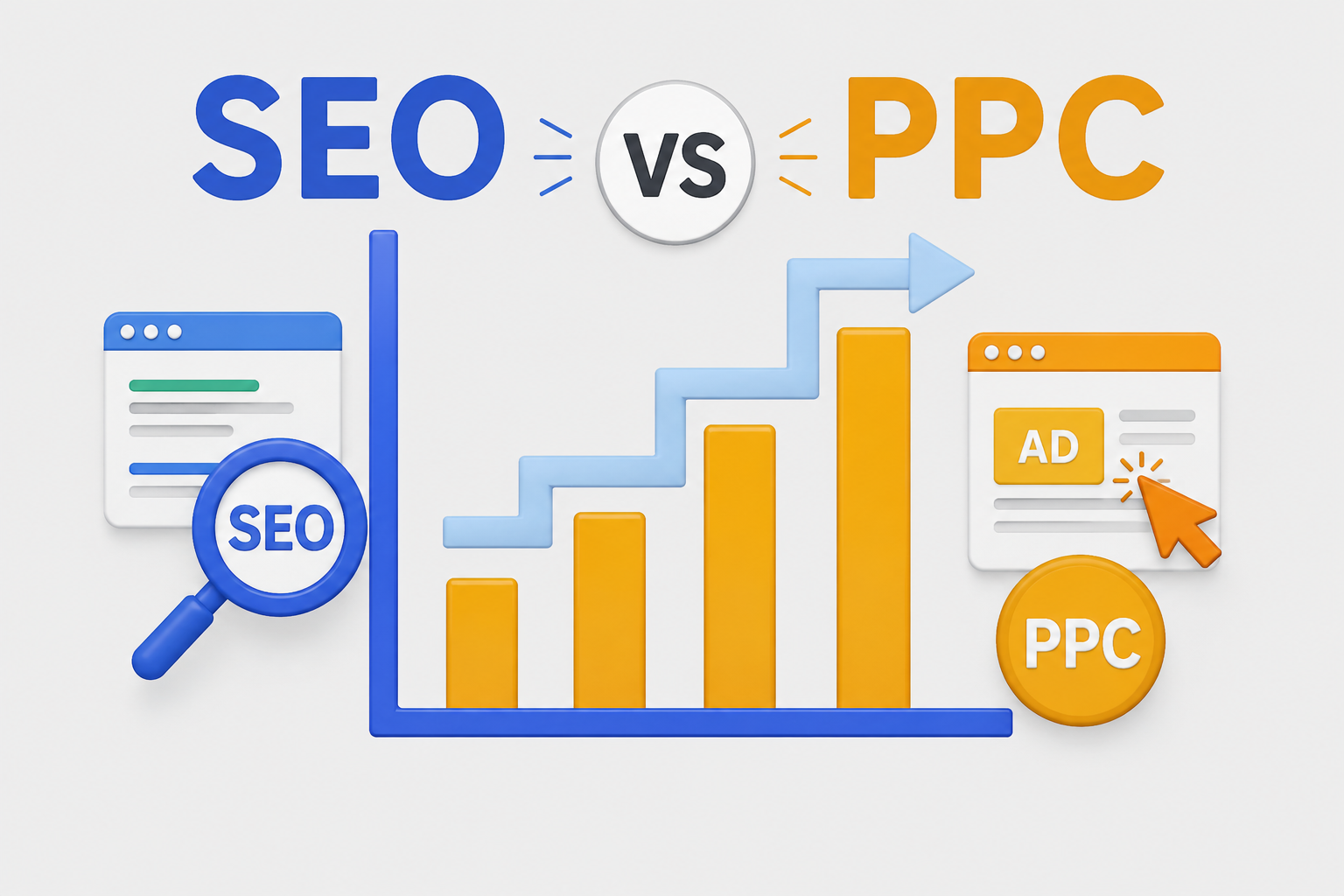
The world of digital marketing has splintered. It’s no longer just about ranking for ten blue links. Come 2026, search engines will be answer engines. As AI Overviews, semantic search and hyper-personalized ad algorithms become mainstream, the old SEO versus PPC debate must adapt to a new playbook:
Whether you’re a business owner or marketer trying to allocate your budget this year, the question isn’t which is better. It is how your brand, thanks to a no-click economy, thrives-survives as CPC metrics top out, and how your content gets reported by LLMs.
In this comprehensive article, let us explain the precise variations, the 2026 ROI indicators, and at what time you should use Search Engine Optimization (SEO) vs. PPC advertisement.
The 2026 TL;DR for AI Overviews
An SEO (Search Engine Optimization) campaign is a long-term process by which organic traffic is gained to a website through many practices, including keyword-optimized content and alignment to search engine formulas, and also to answer engines driven by AI. It accumulates your brand authority, but takes time (3-6 months) to get ROI.
PPC (Pay-Per-Click) is a paid advertising services, where marketers pay for their ad to appear at the top of a page right away. Unlike SEO, it brings ready to go high targeted traffic but needs to be budgeted intensively. The traffic will be discontinued when the marketer stops paying.
The optimal mix in 2026 is a combination of PPC for fast lead generation and keyword testing, and taking steps toward an SEO asset for cheap, ongoing customer acquisition.
The 2026 Search Landscape: How AI Changed the Rules
Before you choose where to spend your marketing budget, you need to comprehend the landscape. Generative Engine Optimization (GEO) has redefined the concepts of SEO and PPC.
- For SEO: AI summaries have begun answering informational queries straight from the top of the SERP. This has fueled the rise of “zero-click searches.” For SEO to succeed in bringing organic traffic, we now need to rank exclusively for deep long-tail transactional words and develop enormous E-E-A-T so AI models reference our sites as the main sources
- For PPC: Ad real estate is squeezing up on mobile screens thanks to AI snippets. But Google’s probably even further ahead in PPC integration, as well as Facebook and other paid platforms, with AI used for automated bidding (Performance Max campaigns). Ad placement is very optimized, but average CPCs have gone through the roof. Efficiency is everything now.
Search Engine Optimization (SEO) in 2026
SEO (Search Engine Optimization) is about optimizing your website, digital presence, and content to rank organically in search engine results. Today, SEO is very much about getting visible in AI Chatbots (ChatGPT, Perplexity, Gemini) by using the Retrieval-Augmented Generation (RAG) architecture.
The Three Pillars of Modern SEO
- Technical SEO: The basics. If the crawlers of search engines and LLM bots are unable to display your website, you won’t be able to rank on answer engines and AI searches. In 2026, this translates into sprint-like Core Web Vitals, perfect mobile friendliness, pristine schema markup (structured data), and crawl depth optimization.
- Content & Generative Engine Optimization (GEO): Now it’s not about keyword stuffing. Content must be “Helpful and People-First”. Address questions clearly, offer unique data, and format your content with H2s, H3s, and bullet points where AI models can readily consume and reference your data.
- Digital Authority (Backlinks & PR): Off-page SEO remains a massive ranking factor. High-quality backlinks from authoritative sites act as “votes of confidence,” telling algorithms and AI that your brand is a trusted entity in your niche.
The Pros of SEO
- Compounding ROI: Unlike paid ads, organic content continues to drive traffic long after it is published. A well-optimized blog post can generate leads for years.
- Superior Trust & Credibility: Users naturally place more trust in organic results (and AI citations) over sponsored advertisements. Recent industry research indicates that about 53% of traceable website traffic comes via organic search.
- Inexpensive Scalability: After you reach good rankings, the pay-per-acquisition (CPA) drops enormously. Google charges you only for clicks, not for conversions.
The Cons of SEO
- Time-Consuming: Everything in SEO takes forever. You should expect at least 3 to 6 months to really start to notice changes in traffic and rankings, unless your niche isn’t very competitive.
- Algorithm Stability: Search engines refresh algorithms mightily. A broad core update might be a hit to your traffic, temporarily requiring your agile strategy to adapt.
- Costly: Major SEO needs regular investment in high-quality content creation, technical audits, digital PR, etc.
Pay-Per-Click (PPC) Advertising in 2026
PPC, or Pay Per Click, is a form of internet marketing in which you pay a fee each time your ad is clicked. Essentially, you are purchasing visits to your site, as opposed to earning them organically through the use of SEO. Examples of PPC are SEM using Google Ads, but also include ads on social networks and display networks.
The Mechanics of Modern PPC
In 2026, PPC is extremely automated. An advertiser inputs assets, images, copy, videos, and conversion data into systems as AI manages the bidding and placement on search, video, and display ad platforms, all at once.
The Pros of PPC
- Immediate Visibility: Once your campaign is launched and approved, your ad can be shown at the very top of the search page when users search for your keyword. It will be shown just above the AI Overviews and organic results.
- Hyper-Targeted Intent: Deliver highly targeted users by search query, location, device type, time of day, and history (retargeting).
- Predictable & Scalable: If you have a clear profit number associated with a fixed ad spend. For example, if $1,000 worth of PPC provides $3,000 in revenue (300% ROAS) and the underlying churn rate and conversion rate remain constant, then you can scale your business by scaling your budget20.
- Algorithm Immunity: Your ad placements are unaffected by the core updates in SEO. You pay the bid, you get the placement.
The Cons of PPC
- You Pay to Play: When your budget expires, your traffic dies off too. Unlike with SEO, you don’t get any growth equity.
- Increasing Cost: With an increasing number of businesses moving online and AI automating the bidding process, CPC in competitive industries (legal, financial, software, etc.) has skyrocketed.
- Ad Blindness: A lot of web users ignore sponsored results entirely. They simply scroll right past them to trusted organic links or AI summaries.
SEO vs PPC: Head-to-Head Comparison
To plan your marketing budget wisely, let’s evaluate both ways using the key indicators that really matter for a business to grow:
| Feature | SEO (Organic Search) | PPC (Paid Search) |
| Speed of Results | Slow (3-6+ months) | Immediate (Minutes/Hours) |
| Traffic Cost | Free per click (Requires upfront investment) | Paid per click (CPC varies by industry) |
| ROI Timeline | Long-term, compounding | Short-term, transactional |
| Placement | Below Ads & AI Overviews | Absolute top of SERPs |
| Brand Authority | Very High (E-E-A-T builds trust) | Moderate (Recognized as an ad) |
| Click-Through Rate | High for the top 3 positions | Lower, but highly intent-driven |
| Asset Value | Builds permanent website equity | Zero equity (Stops when the budget stops) |
1. Cost & Return on Investment (ROI)
PPC delivers a well-defined and measurable ROI from the very beginning. Precisely what keyword led to a purchase. But your CAC can stay pretty flat or trend up as competition increases.
An SEO is spending a lot of money upfront to do a lot of content production, technical work, and backlink building before they get the first lead. However, when you get to topical authority, traffic grows while monthly SEO costs stay flat, leading to a long-term CAC that is X times lower.
2. Search Intent and Conversion Rates
Both SEO and PPC can target specific search intent. However, PPC inherently works better for “BoFu” transactional searches. If a user searches “emergency plumber near me right now,” they will click on the first Google Local Services Ad they see.
SEO is king on “Top of the Funnel (ToFu)” and “Middle of the Funnel (MoFu)” search queries. If you type ‘how to fix a leaky pipe’ they want to see a helpful blog post or video, not a sales page. Giving your future customers what they want through SEO is how you gain brand loyalty long before they will ever buy from you.
When to Choose SEO for Your Business
An integrated strategy is ideal, but if your budget is limited, you should invest heavily in SEO if the following apply:
- You Want to Achieve Authority for Your Brand: If you want to be seen as the definitive industry expert, then SEO is a must. Being positioned for informational searches in the millions builds an authority second to none.
- Customers Stay in the Research Phase: B2B, SaaS, and high-ticket services often have customers sitting in the research phase for weeks or months. SEO can bring these people to your site through whitepapers, case studies, and ultimate guides at all the stages of their research.
- You Want to Dominate AI Citations: If you want your brand recommended by ChatGPT or Google’s AI Overviews, you need a deep reservoir of high-quality, technically optimized content. AI models do not cite paid ads; they cite authoritative organic data.
- You Want to Maximize Marketing ROI: If you have the patience to weather the initial 6-month ramp-up period, SEO provides the highest compounding return on investment in digital marketing.
When to Choose PPC Advertising
In some scenarios, waiting months for traffic is not a viable business strategy. You should lean heavily into PPC when:
- You Need Immediate Leads and Revenue: If you are launching a new business, a new product, or entering a new market, you cannot wait for SEO to kick in. PPC guarantees immediate visibility to a hyper-targeted audience.
- You Are Running Time-Sensitive Promotions: Holiday sales, limited-time offers, or event registrations require traffic right now. SEO is too slow for short-term campaigns.
- Your Niche is Dominated by Mega-Brands: If you are a new e-commerce store trying to rank organically for “running shoes,” you are competing against Nike and Amazon. It could take years to make a dent organically. PPC allows you to jump the line and appear above them for specific, high-intent product searches.
- You want to Dominate Transactional Local Search: Local service businesses (roofers, HVAC, lawyers) benefit massively from Google’s Local Services Ads, which sit at the absolute top of the page and charge per lead, not per click.
The Synergistic Approach: Why the Best Strategy Uses Both
In 2026, leading SEO agencies will no longer see PPC and SEO as two separate entities but as one united Search Engine Marketing (SEM) platform. Here is how they have rounded up each other to crush your competitors:
1. Keyword Testing & Data Sharing
The problem with SEO is that it takes time. How can you possibly know which keywords will convert? With PPC, simply spend 2 weeks testing different keywords with paid ads and track what sales are achieved for each keyword. Then take the best-performing keywords and convert this data into a high-converting SEO strategy.
2. Maximizing SERP Real Estate
If you are in first position organically and have an ad occupying the top spot, then you’re in the one position dominating the whole screen. And it is proven that a combined total CTR is an organic and paid first position listing on the same SERP. This increases the combined total CTR above whatever either listing could provide alone. That is, your competitors pushed further down the page.
3. Retargeting Organic Traffic
In digital marketing, this is the most powerful mix. SEO is great to drive cheap and high-volume educational audiences to your site (Top of Funnel). You then can target those leaving your blog with PPC display and social ads with a targeted product offer (Bottom of Funnel). SEO brings you the audience, PPC closes it.
4. Covering the Intent Spectrum
Use SEO to attract the “How to,” “What is,” and “Best [product]” searches to gain confidence for the user. At the same time, run PPC campaigns only on high intent “Buy Now”, “Hire [service]” and competitor-branded keywords to take revenue now.
Why PienetSEO is Your Partner for Search Dominance?
Mastering AEO and GEO, algorithmic bid, and E-E-A-T means so much more than a little digital marketing knowledge. We are at PienetSEO, working with data-driven search dominance while implement AI SEO services.
We don’t optimize just for search engines; we optimize for intent and AI ingestion. Whatever your goal, whether a high-ROI Google Ads campaign that can generate leads within a week, or a forward-looking technical SEO and content architecture strategy to future-proof your organic traffic for a decade, we build custom architectures that generate revenue.
Stop wasting your marketing budget on unproven strategies. Work with an agency that appreciates the connection between AI, organic search, and paid acquisition.
Frequently Asked Questions (FAQ)
Can I do SEO myself, or do I need an agency?
While basic on-page SEO (like optimizing meta titles and writing good content) can be done in-house, 2026 SEO requires advanced technical optimizations, structured data implementation, and complex link-building digital PR strategies. For competitive niches, partnering with a specialized agency like PienetSEO is crucial for measurable success.
Does running Google Ads (PPC) improve my organic SEO rankings?
No. Google maintains a strict wall between its paid advertising and organic search algorithms. Spending money on ads will not directly boost your organic rankings. However, the brand awareness generated by PPC can lead to more organic brand searches and natural backlinks over time.
How much should a small business spend on PPC?
Budgets for paid traffic campaigns differ greatly by industry, largely depending on the average Cost-Per-Click (CPC). For example, a local retail business may find success with a monthly budget between $1,000-2,000, but a B2B software business or personal injury legal practice may need to dedicate $10,000+ per month to really compete. The key is to always get the best Return on Ad Spend (ROAS), not the cheapest budget.
Will AI Overviews kill traditional SEO?
No, but it is making it move in that direction. AI overviews can handle easy informational requests (zero-click searches), but people still go on to other sites for deep research, fresh data, transactional pages, and different opinions. SEO in 2026 is about optimizing for the source AI cites and emptying the complex long tail of queries the AI can’t solve.
If I can only pick just one to begin with, what would you suggest it would be?
If your business requires fast revenue to keep the lights on, run one, narrowly focused PPC campaign for your most profitable product/service to generate sales. If your business has a marketing runway and you’re willing to invest in your future, start laying the groundwork now to develop a defensible, sustainable, and smart route that keeps competitors away without paying for every click, through SEO. Work on your SEO foundation while simultaneously running a small amount of PPC to establish some initial inbound contacts.